Quick Verdict for 2026
- Choose Flutter if: You need custom 60/120fps animations, pixel-perfect brand consistency across platforms, heavy offline data modeling, or a high-performance gaming/fintech/productivity app.
- Choose React Native if: You have an existing React/Next.js web team, rely heavily on native platform UI components (standard Apple UIKit buttons/pickers), or require instant Over-the-Air (OTA) updates via Expo.
- Both Deliver: Substantial 40% cost reductions over maintaining dual Swift and Kotlin codebases, identical App Store acceptance rates, and tier-one community ecosystems.
In 2026, the debate between Google's Flutter and Meta's React Native is no longer about whether cross-platform apps can match native code. Both frameworks run applications with hundreds of millions of downloads—from Nubank and BMW to Shopify and Discord. The real question for founders and product leads is: Which framework optimizes for your team's velocity, design vision, and long-term operating costs?
1. Architectural Differences: Impeller vs The New React Native Architecture
To make an informed technical decision, you must understand how each framework draws pixels onto a phone screen:
Flutter (Impeller Engine)
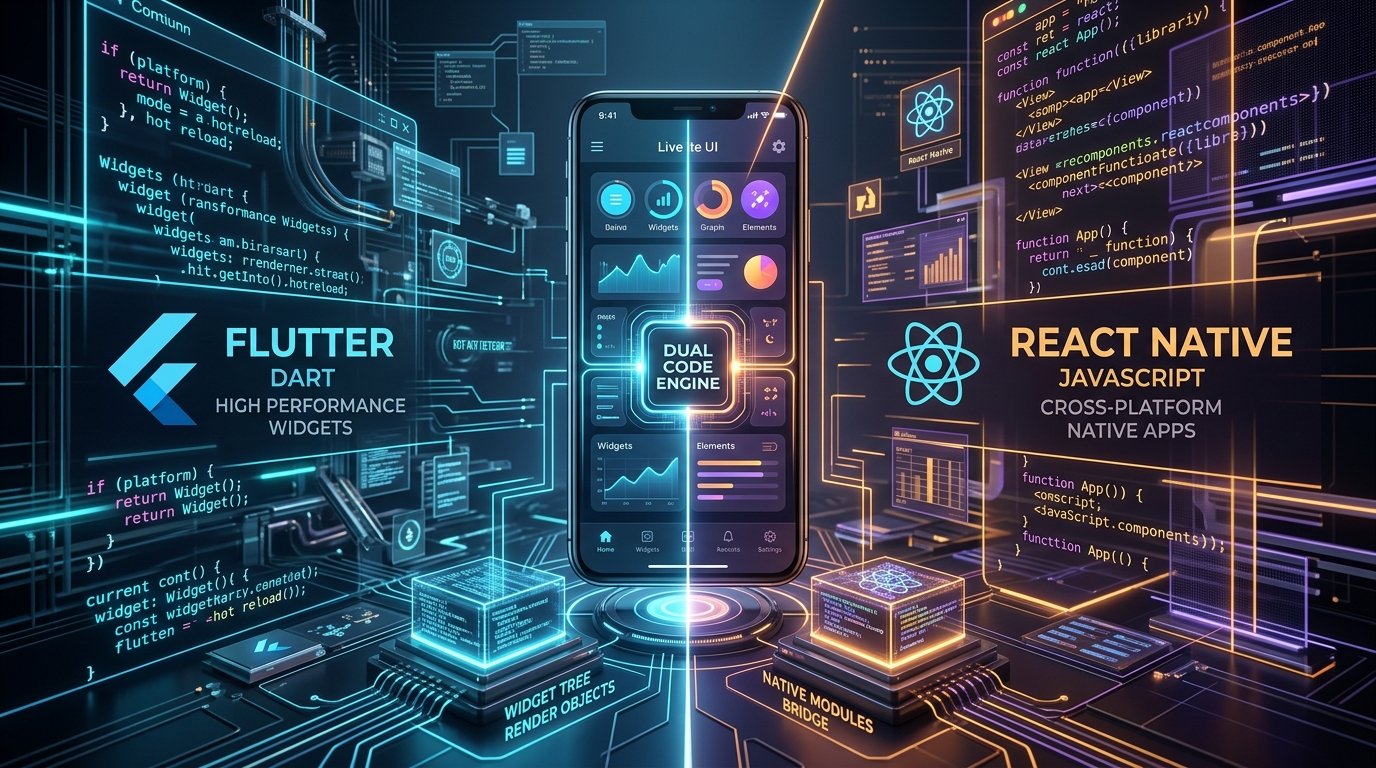
Flutter operates like a game engine. It does not wrap native iOS or Android UI controls. Instead, it compiles Dart code directly to native machine instructions (AOT) and renders every pixel using Impeller, a custom Vulkan/Metal rendering backend. Because Flutter controls every pixel directly, your app looks completely identical whether it runs on an iPhone 16 Pro, an Android budget phone, or a web browser.
React Native (Fabric & TurboModules)
React Native translates React components into genuine platform-native widgets (e.g. `UIView` on iOS, `android.view.ViewGroup` on Android). With the modern New Architecture (Fabric renderer + JSI direct JavaScript-to-C++ bindings), the old asynchronous "bridge" bottleneck is completely eliminated. JSI provides zero-overhead direct communication, eliminating animation lag that plagued older versions.
| Benchmark | Flutter (Dart) | React Native (TS/JS) |
|---|---|---|
| Rendering Engine | Impeller (Direct GPU rendering) | Fabric (Native OS Widgets via JSI) |
| Animation & Frame Consistency | Exceptional (Locked 60/120fps) | Very Strong (Reanimated 3) |
| Web & Desktop Support | First-Class (macOS, Windows, Linux, Web) | Good (React Native for Web) |
| Over-The-Air (OTA) Updates | Limited (Shorebird) | Native Standard (Expo EAS Updates) |
| Talent Availability | Growing Fast (Dart is easy to learn) | Massive (Leverages universal JS/TS talent) |
2. Developer Velocity: Who Ships Faster?
For an early-stage startup, speed to market is oxygen. In our studio's benchmark tests building comparable MVPs across both stacks:
- Flutter Wins in UI Velocity: Flutter's exhaustive standard library of Material 3 and Cupertino widgets means you almost never need external UI libraries. Everything from complex sliver app bars to nested navigation and hero transitions works out of the box.
- React Native Wins in Full-Stack Synergy: If your web app is written in React or Next.js, your team can share validation logic (Zod), TypeScript types, API query hooks (TanStack Query), and utility functions between the website and mobile app seamlessly.
Unsure Which Stack Fits Your App Idea?
We review your feature specs and design mockups to advise the exact right architecture for your budget, timeline, and growth goals.
Book Free Architecture Consultation3. The Verdict: How Firebrick Studio Selects Your Stack
At Firebrick Studio, we don't believe in dogmatic allegiance to a single tool. We select frameworks based strictly on business outcomes:
When clients approach us with heavily customized consumer products like our gamified habit app LevelUp or our offline audiobook player Audio Shelf, we choose Flutter for its flawless local SQLite integration and buttery 60fps canvas animations. When clients need a high-velocity B2B SaaS companion app tethered to a Next.js web application, React Native with Expo is often the winning play.